
THE TURNKEY RETIREMENT SURVIVAL BLOG
Navigating the Life Side of
Retirement
Retirement is more than money. It's identity, purpose, relationships,
technology, income, faith, and learning how to design the next chapter
with intention.
FEATURED POSTS
_____________
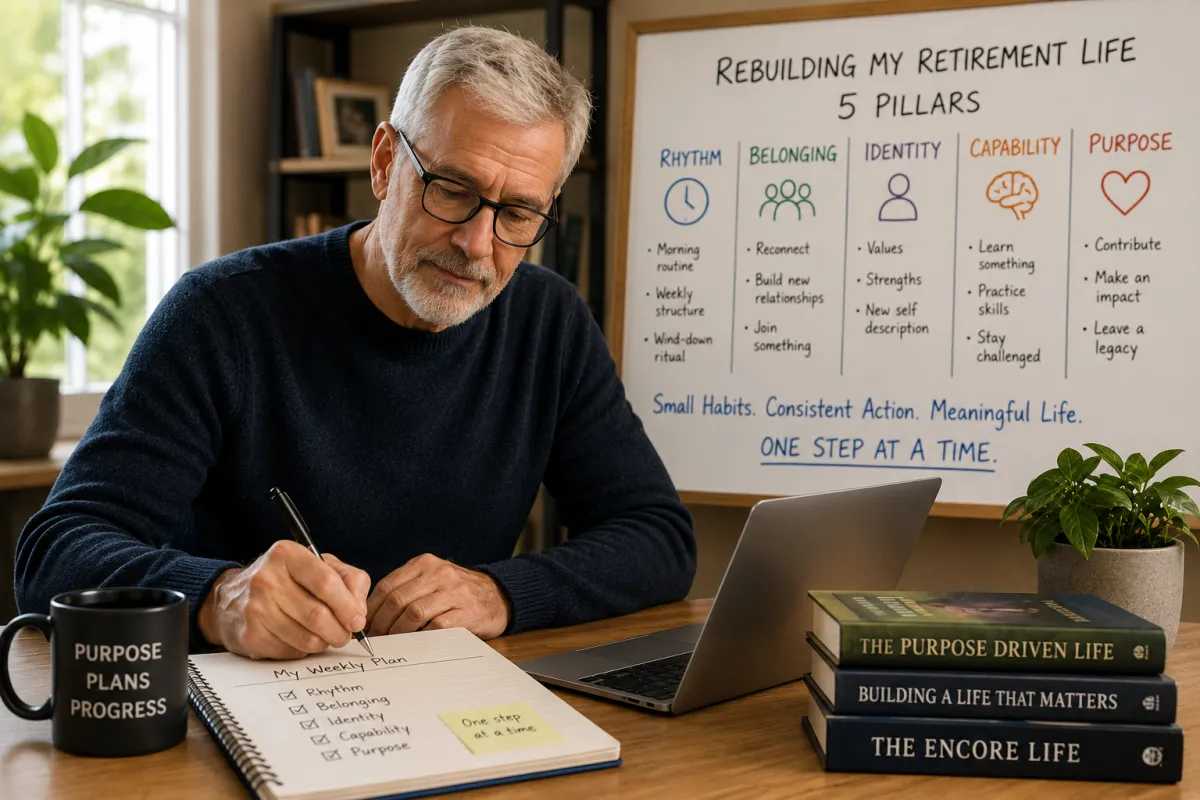
How to Rebuild Your Retirement Life: A 10-Week Plan for Rhythm, Purpose, and Belonging
This is Part 3 of a 3-part series on the hidden challenges of the retirement transition. If you haven't read Part 1 — I've Saved My Whole Life. Why Can't I Sleep? and Part 2 — Who Are You Now?, start there. Everything we cover today builds on the foundation laid in those two posts.
By now, you understand the problem.
You know that retirement doesn't just change your schedule, it disrupts five fundamental pillars that your career was quietly providing for free: Rhythm, Identity, Belonging, Capability, and Purpose. You know that this disruption is why so many financially prepared retirees still struggle with restless nights, anxious days, and a nagging sense that something is missing.
And you know that this is not a personal failing. It's a design problem, one that can be solved with the right framework.
That framework is what this post is about.
What follows is a practical, week-by-week approach to rebuilding all five pillars, one small, sustainable habit at a time. This isn't about filling every hour. It isn't about performing busyness. It's about building a life in retirement that has enough structure, meaning, connection, challenge, and contribution to feel genuinely worth living, including sleeping well at night.
Let's get into it.
Before You Begin: Take Your Pivot Readiness Score
If you haven't already done this, do it now, before reading the rest of this post.
The Pivot Readiness Score is a free self-assessment that walks you through all five pillars and gives you a score out of 40, with a subtotal for each area. It takes about 15 minutes and gives you a clear, honest picture of where you're strong and where you need to focus.
Get your free Pivot Readiness Score HERE!
The reason this matters for what follows: you don't need to work on all five pillars equally. Nobody does. Your score will tell you which one or two pillars are your weakest links, and that'swhere your energy should go first. Trying to overhaul everything simultaneously is the fastest way to overwhelm yourself and quit.
Got your score? Good. Now let's build your plan.
The Architecture of a Rebuilt Retirement Life
Before we get into the week-by-week specifics, I want to offer a mental model that I think changes how people approach this.
Think of your retirement life as a building under construction. You can't start with the top floors. You have to begin with the foundation, then build up.
The foundation, and the place almost everyone should begin, is Rhythm. Without a basic structure for your days and weeks, everything else is harder. Sleep is worse. Motivation is lower. Social life is more chaotic. But when Rhythm is working, the other pillars become much easier to build.
From Rhythm, the next layer is Belonging. Human connection provides the energy and accountability that makes Identity, Capability, and Purpose work sustainable. It's very hard to build a meaningful retirement life in isolation.
With Rhythm and Belonging as a base, you can tackle Identity, which often clarifies naturally as you become more embedded in your new routines and communities. And from a stable Identity, Capability and Purpose tend to emerge with much less effort.
This is the order I recommend. It's not rigid, your Pivot Readiness Score may tell you otherwise, but it reflects the sequence that tends to produce the fastest, most durable results. You can also use our Retirement Plan Builder to put a personalized structure around these priorities before you begin.
Week 1–2: Rebuild Your Rhythm
Your first and only goal in weeks one and two is to create a working daily structure. Not a perfect one. Not a packed one. Just one with enough anchors to give your brain reliable "on" and "off" signals.
The Morning Anchor
Choose one action, just one, that will signal to your brain that the day has begun. It shouldbe:
Consistent (done at roughly the same time every day)
Physical or sensory (something your body experiences, not just a thought)
Brief (10–20 minutes maximum)
Low-barrier (something you can do even on your worst days)
Good examples: brewing coffee and drinking it before looking at your phone, a 15-minute walk around the block, five minutes of journaling, a short stretching routine, reading something inspiring for 10 minutes.
The content matters less than the consistency. Do it every day for two weeks without exception. This is your new launch signal.
Research from Duke University behavioral scientist Wendy Wood shows that nearly half of our daily actions are driven by habit rather than conscious decision, which means the fastest way to change how your days feel is to change the habitual cues that start them.
The Weekly Template
Beyond the morning anchor, sketch out a loose weekly template, not a tight schedule, but a set of themes or categories for each day. For example:
Monday: Administrative tasks, errands, phone calls
Tuesday: Creative or learning time
Wednesday: Social connection (lunch, coffee, club, volunteer)
Thursday: Creative or learning time
Friday: Personal enjoyment, reflection, planning the week ahead
Weekend: Family, rest, spontaneity
The specifics are entirely yours. What matters is that different days feel different, that Monday doesn't bleed into Thursday doesn't bleed into Saturday until the whole week is one undifferentiated blur.
The Wind-Down Signal
Just as important as the morning anchor is a consistent wind-down ritual at night. Pick a time, say, 930 p.m. and create a small sequence of actions that signals to your brain that the day is done. Dim the lights. Put the phone in another room. Make a cup of herbal tea. Read something calm and absorbing.
The National Sleep Foundation recommends a consistent pre-sleep routine as one of the most effective non-pharmaceutical interventions for sleep quality in adults, and this is especially relevant for retirees whose natural sleep cues have been disrupted by the loss of work structure.
Your Week 1–2 commitment: One morning anchor. One weekly template (rough). One wind- down ritual. That's it. Don't add anything else yet.
Week 3–4: Rebuild Your Belonging
With basic Rhythm in place, weeks three and four are about reconnecting with other human beings in a structured, recurring way.
As we discussed in Part 2 of this series, loneliness in retirement is not just an emotional discomfort, it's a genuine health risk. And the antidote isn't more casual socializing. It's belonging, being part of a community that expects you and values your presence.
Identify One Community to Join or Rejoin
Think about where you've felt most seen and useful in the past, not just comfortable, but genuinely needed. Now ask: is there a community in my current life that creates that feeling, or something close to it?
If yes, make a commitment to show up consistently for the next four weeks. Weekly is the minimum. Twice weekly is better.
If no, it's time to find one. Some options to consider:
Volunteer roles with organizations that have a clear mission and regular schedules (food banks, libraries, literacy programs, animal shelters, Habitat for Humanity)
Interest-based clubs with a strong meeting culture (hiking groups, book clubs, garden societies, choir, maker spaces, chess clubs)
Learning communities (community college courses, community theater, art classes, language learning groups)
Faith communities, if that resonates
Professional communities in a lighter form (mentoring programs, advisory boards, alumni networks, industry associations)
The Corporation for National and Community Service reports that adults who volunteer regularly show lower rates of depression and greater life satisfaction than their non-volunteeringpeers, making community service one of the most evidence-backed ways to rebuild belonging in retirement.
The key criteria: shared mission, predictable schedule, recurring commitment. You want a community where people will notice if you don't show up, because that expectation is what creates belonging.
Restore One Lapsed Relationship
Think of one person from your working years, a former colleague, a client, a mentor, with whom you had a genuinely good relationship that has quietly faded since retirement. Reach out. Not with a grand gesture, just a simple message: "I've been thinking about you. Can we find a time to catch up over coffee?"
One relationship, intentionally renewed, can have a surprisingly large emotional impact. And it often opens the door to more.
Schedule Socialization Like an Appointment
One of the most practical shifts you can make in retirement: stop treating social connection as something that will happen naturally, and start scheduling it like a meeting. Because in the absence of a workplace structure, it won't happen naturally, or at least not with the frequency and variety that your wellbeing requires.
Put it on the calendar. Protect it. Show up.
Your Week 3–4 commitment: Join or recommit to one recurring community. Restore one lapsed relationship. Schedule at least two social touchpoints per week.
Week 5–6: Clarify Your Identity
By week five, you have rhythm and at least the beginning of belonging. This is the right time to do the deeper identity work, because now you have enough stability and social context to think clearly.
As we covered in Part 2, the most common mistake people make at this stage is reaching for a replacement label. The stronger path is to rebuild identity from values outward.
Write Your Present-Tense Introduction
This is the exercise I mentioned in Part 2, and it's worth doing properly.Set aside 30 minutes. Sit somewhere comfortable with a journal or notebook. Answer these three questions in writing:
What do I care about most deeply, the causes, problems, or communities that genuinely move me?
What do I bring to any room I enter that has nothing to do with my former job title?
Who benefits when I show up fully and consistently?
From your answers, draft a two or three sentence introduction of yourself. Present tense. Future- leaning. Not a job title, a statement of direction and value.
Try it out loud. Refine it. Try it in a real conversation. Keep refining it until it feels true.
This isn't vanity. It's navigation. A clear sense of who you are in this chapter makes every other decision, what to pursue, what to decline, where to invest your time, dramatically easier. For more on how this kind of narrative identity work shapes retirement wellbeing, our post on making peace with the road not taken explores the research in depth.
Update Your Visible Signals
Once you have a working identity statement, let it inform the visible signals of your life. Update your social media bio. Revise how you introduce yourself at community events. If you have a personal website, refresh it.
These may feel like small, cosmetic changes. They're not. They're acts of commitment, declarations that the old chapter is closed and the new one has begun.
Your Week 5–6 commitment: Complete the identity writing exercise. Draft your present-tense introduction. Update at least one visible signal of your identity.
Week 7–8: Activate Your Capability
By now, your days have shape. Your social life has intentional structure. Your sense of self is clarifying. This is the right time to add a meaningful challenge.
Choose One Skill to Build
Pick something that stretches you at the right edge, challenging enough to require real effort, achievable enough that progress is visible. Ideal choices have a built-in feedback loop: you know when you're improving.
Great options for retirement capability building:
A language (apps like Duolingo provide daily feedback)
An instrument (weekly lessons create accountability)
A physical skill (strength training, swimming, tennis, golf with tracked stats)
A creative skill (writing, painting, photography, woodworking)
A technical skill (coding, video editing, design)
Teaching or mentoring in your area of former expertise
The research on cognitive aging is clear: continued learning is one of the most powerful protections against cognitive decline. The Alzheimer's Association identifies staying cognitively active as a key protective factor, and acquiring new skills, as opposed to simply practicing familiar ones, generates the most significant neurological benefit.
But beyond the neuroscience, there's something deeply satisfying about getting better at something, about seeing tangible evidence that you are still growing, still capable, still becoming.
Define What a "Rep" Looks Like
Whatever skill you choose, define the minimum unit of practice. A rep. A session. A page. A mile. A lesson.
Then decide how many reps per week. Put them on your calendar. Track them somewhere visible, a simple checkbox in a notebook is enough.
Visible progress is motivating. Hidden progress is easy to underestimate and therefore easy to quit.
Your Week 7–8 commitment: Choose one skill to build. Define your practice rep. Schedule at least three practice sessions per week. Track them.
Week 9–10: Anchor Your Purpose
The final pillar, and in many ways the most profound, is Purpose. This is the felt sense that your effort matters beyond yourself. That someone benefits because you show up. That your absence, in at least one area of life, would be noticed and felt.
Psychologist Martin Seligman's PERMA model of wellbeing places Meaning, the sense that one belongs to and serves something larger than oneself, as one of five essential components of flourishing. And research from Stanford's Center on Longevity consistently shows that a sense of purpose is one of the strongest predictors of health and longevity in older adults.
In retirement, purpose doesn't have to be grand. It just has to be real.
Name Your Beneficiary
Purpose becomes real when it's connected to a specific person or community, not an abstract cause.
Ask yourself: Who is better off because of what I do? If you're mentoring, name the person. If you're volunteering, picture the faces of the people you serve. If you're creating something, writing, teaching, building, imagine the reader, the student, the recipient.
Abstract purposes are easy to deprioritize. Concrete beneficiaries are not. When you can picture a specific face, it becomes much harder to cancel on them.
Schedule Your Purpose Work Like It Matters — Because It Does
Whatever your purposeful contribution looks like, protect time for it on your calendar the same way you'd protect time for a medical appointment. This is not optional leisure. This is essential maintenance for your sense of meaning, and therefore for your sleep, your energy, and your overall wellbeing.
A practical structure: commit to showing up for your purpose at least once per week, at a specific time, in a specific place. Let it become as predictable and expected as the morning anchor you built in Week 1.
Your Week 9–10 commitment: Name one specific beneficiary of your effort. Schedule your purpose contribution at least weekly. Let it be non-negotiable.
The Ongoing Practice: Weekly Recalibration
Once you've completed the ten-week build, the work isn't finished, it just changes character. Now the goal is maintenance, deepening, and recalibration.
I recommend a brief weekly review ritual, Friday afternoon or Sunday evening works well for most people. Ask yourself three questions:
Which pillar felt strongest this week?
Which pillar felt weakest?
What one small action will I take next week to strengthen the weakest one?
That's it. Five minutes. One question per pillar, one action committed. Over time, this simple
ritual creates a feedback loop that keeps your retirement life from drifting, and gives you earlywarning when one of the pillars starts to wobble.
You've Done the Hardest Part
The hardest part of rebuilding a retirement life isn't the doing. It's the recognizing, acknowledging that something is off, understanding why, and deciding to do something about it intentionally rather than just waiting to feel better.
You've done that part. You're here, reading this. And that puts you ahead of the vast majority of retirees who are struggling without a framework to understand what's happening or a plan for how to change it.
The ten weeks ahead of you are not a burden. They're a design project, and the thing you're designing is a life that has structure, meaning, connection, challenge, and contribution baked into every week.
That's the kind of life that lets you fall asleep at night.
Your Next Step
If you haven't taken the Pivot Readiness Score yet, that's step one. It takes 15 minutes, it's completely free, and it will tell you exactly which of the five pillars to prioritize in your ten-week rebuild.
Get your free Pivot Readiness Score HERE!
You can also visit our Retirement Plan Builder to build a personalized lifestyle roadmap, and browse the full Retirement Reinvention blog for more articles on navigating every dimension of the retirement transition.
And if you're ready to go deeper, if you want a more comprehensive guide to building your retirement life on purpose, the Retirement Survival Secrets ebook walks through each of the five pillars in full detail, with exercises, real-world examples, and a complete implementation guide.
Get the Retirement Survival Secrets ebook for $19
Thank you for spending time with this series. It has been my genuine honor to walk through this material with you. Retirement is not an ending, it's a pivot. And you now have everything you need to make it a great one.
Bill Bergfeld is the founder of Retirement Survival Secrets and a contributor to the Retirement Reinvention blog. Download the free Pivot Readiness Score.

BROWSE BY TOPIC
Explore the Categories

Retirement Mindset
Identity - Purpose - Transition

Retirement Income
Strategy - Side Income - Security

Faith & Purpose
Calling - Meaning - Community

Retirement Technology
Tools - Apps - Staying Current

Health & Wellness
Longevity - Energy - Vitality
FREE RESOURCE
Want to build purpose, income,
and confidence in retirement?
Join thousands of retirees who are designing their next chapter
with intention - not just hoping it works out.
Clarify your identity beyond your career
Build flexible retirement income
Rediscover purpose and faith
No spam. Just straight talk for the life side of retirement.
2026 Turnkey Services Pro ~ Privacy Policy ~ Home ~ Blog